
The foreign exchange (forex) market is the biggest financial market in the world, and it runs around the clock because trading moves through major financial centers as they open and close. That’s why people say forex is “open 24 hours.”
But that availability can mislead you. Just because the market is open does not mean it is moving. You can take a clean setup, manage it well, and still watch the price go nowhere for hours. This dead-trade feeling drains your focus, and it often pushes you to close a position out of frustration. Then the market finally moves, but only later, when liquidity returns.
If this is making you doubt your system, pause before you throw away your rules. The issue is often not your strategy. It’s when you are using it.
A good strategy needs high liquidity (money flow) and volatility (movement) to work. The best time to trade forex is not a secret, lucky moment. It is usually a predictable window created by institutional activity. Mastering timing in forex requires understanding the specific time of day you enter your trade, how the major global forex trading sessions influence liquidity and movement, how the day of the week affects overall market activity, and how major economic news releases can trigger sharp price swings.
This article will clearly explain why the success of your trade often comes down to when you execute it. We will detail how the global forex market hours directly control the movement required for your trade setups to succeed. If you already have a solid system but struggle with consistent results, learning market timing is the necessary next step.
What “Timing” Really Means in Forex Trading
Many new traders misunderstand what “timing” means in the currency market. People often confuse it with trying to predict the exact minute a price will hit its absolute peak or bottom. That kind of minute-by-minute prediction is hard, and it usually leads to frustration.
In professional trading, timing in forex has a practical, systematic meaning. It is about aligning your actions with the predictable activity cycles of major banks and financial institutions. It is about knowing when the money is moving, not where it is going.
Effective market timing comes down to four parts: the trading session and time of day, the day of the week, major news release windows, and your personal schedule and focus.
The session you trade matters most because time of day drives liquidity and volatility for specific currency pairs. For example, EUR/USD often moves more during London and New York business hours than during the Asian session.
Activity also shifts by day. Tuesday, Wednesday, and Thursday often bring more volume and range, while Monday can start slow and Friday afternoons can fade quickly.
News timing matters too. Scheduled high-impact releases like rate decisions or employment data can create sudden spikes in volatility. Good timing means knowing when those events hit so you can either avoid the chaos or trade it with a clear, high-risk plan.
Timing has a personal side as well. Trade when you are mentally sharp and can monitor positions without distraction. Even the best hours are useless if you are tired or unfocused and you cannot follow your rules.
For this article, we will focus on the first three technical pieces: trading sessions, market hours, and news releases, since these are the objective factors that shape market behavior.
Why Timing Matters More Than Most Struggling Traders Think
If you struggle with consistency, timing can feel like a minor detail. It is not. Timing controls the market conditions your strategy has to face.
Market conditions change across the day in three main ways: liquidity (how easily you can buy or sell without much price distortion), volatility (how far and fast price moves), and spreads (your cost of trading). When major centers are open, banks place large orders and liquidity rises. Spreads often tighten. When liquidity drops, spreads can widen, and price can drift in narrow ranges.
The same setup can behave very differently depending on those conditions. Imagine you spot a clean breakout on EUR/USD. If you enter during a slow Asian hour, price may drift sideways, and the breakout may fail. If you enter that same pattern during the London-New York overlap, liquidity is deeper and volatility is higher, so price is more likely to move decisively toward a target or a stop.
Bad timing also creates psychological burnout. When a trade sits dead for hours, you start second-guessing, tweaking rules, moving stops, or forcing action with weaker setups. You end up abandoning a strategy that may be fine, just because you did not give it active market conditions.
If your strategy works sometimes but feels dead many times, your timing is the prime suspect. Your goal is not to trade all day. Your goal is to find one or two short windows when the market is awake and ready to move.
Forex Market Hours and Sessions: When the Market Really Moves
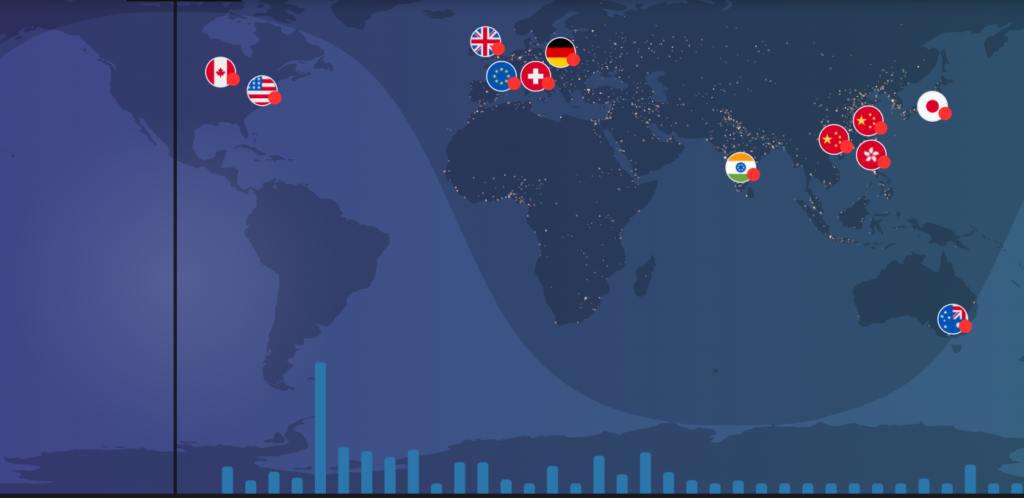
The forex market runs 24 hours a day, five days a week, but it is not active everywhere at once. The 24-hour cycle works like a relay race. Four major financial centers take turns driving volume and movement.
The four main sessions are Sydney, Tokyo, London, and New York, and traders often reference them in UTC to keep times consistent. Sydney runs about 10:00 PM to 7:00 AM UTC and it tends to be the quietest for major pairs. Tokyo runs about 12:00 AM to 9:00 AM UTC and activity shifts more toward JPY, AUD, and NZD pairs. London runs about 7:00 AM to 4:00 PM UTC and it usually brings the highest liquidity and the strongest trends in major pairs. New York runs about 12:00 PM to 9:00 PM UTC and volatility can spike, especially around major US data releases.
Each session has its own personality. Sydney often prints smaller, range-bound moves on pairs like EUR/USD and GBP/USD. Tokyo can be a better fit when you trade JPY- and AUD-linked pairs, even if the euro and pound still move less than they do later in the day. London is the main volume driver and it often breaks the earlier range. New York can extend trends or reverse them, and it is also a key window for USD pairs and for Gold (XAU/USD).
The most important window for many traders is the London-New York overlap, usually around 12:00 PM to 4:00 PM UTC. Both centers are open, liquidity is deepest, volatility is often highest, and major pairs like EUR/USD tend to move more cleanly, which helps trades reach targets faster.
If you want maximum movement, focus on that overlap and build your routine around it. Session indicators and market-hours converters can help you translate those windows into your local time so you are not guessing.
Best Time to Trade Forex for Common Trader Profiles
Understanding the sessions is only the first step. The more practical step is matching those active hours to your real life and your location. You are not trying to trade for 12 hours a day. You are trying to identify one or two short, high-quality windows that fit your schedule and give your pairs the best chance to move.
Here’s how three common global profiles can build a practical trading routine.
If You Live in Europe or Africa (Focus: London and the Overlap)
If you are based in Europe or Africa, you have a real advantage. The most active part of the forex day often happens during your normal working hours.
Your main opportunity is the London session, and the best window is usually the London-New York overlap. The London open, around 7:00 AM UTC, often brings the first strong push of the day and it can suit breakout and volatility-based setups. For many traders, the three hours leading into the overlap and the early part of the overlap, around 10:00 AM to 1:00 PM UTC, is where the market moves most cleanly on major pairs like EUR/USD and GBP/USD.
This is also a realistic window for busy people. Even a focused 60 to 90 minutes during lunch or early afternoon can be enough. You often get feedback faster in this window, which means less time staring at a chart waiting for something to happen.
If You Live in Asia (Focus: JPY, AUD, and Early London)
If you live in Japan, Australia, Singapore, or nearby time zones, Sydney and Tokyo are your home sessions. That is your natural activity period. The mistake many traders make is trying to force trades on quieter pairs like EUR/USD during those hours and then blaming their strategy when price barely moves.
Your best windows are the Tokyo session and, if your schedule allows it, the first two hours of the London session. During Tokyo hours, focus on pairs that are closely tied to the region such as USD/JPY, AUD/USD, and NZD pairs. These often show their clearest moves when Asia is driving the market. If you can stay up later, the start of London can also be useful because it often breaks the Asian range, which can create clean opportunities before you call it a day.
The practical move here is simple. Build your schedule around your regional strengths. Trade JPY and AUD pairs during your morning or early afternoon, and only chase London if it fits your lifestyle.
If You Live in North America (Focus: New York Open and the Overlap)
If you are in the United States or Canada, you are well positioned for the New York open and the overlap with London. This is when liquidity is deep and volatility can spike, especially because many high-impact US news releases happen in this window. That often drives strong movement in USD pairs and in Gold (XAU/USD).
For many North American traders, the best routine is to focus on the morning period that overlaps with London. If you work a traditional job, you can analyze and plan during the first part of the overlap before work, or trade the early New York session later in the day, as long as it still aligns with strong activity.
Try to avoid the later part of the New York session once Europe closes. Volatility often drops, and the market can turn quiet, which increases the odds of slow, frustrating trades.
The Overriding Principle
No matter where you live, you do not need to trade all day. You only need one or two clear windows that match your life and the activity cycle of your chosen pair. Once you build a consistent schedule around those windows, you stop trading randomly, and you start executing with better conditions on your side.
The Worst Time to Trade Forex and Why It Drains You
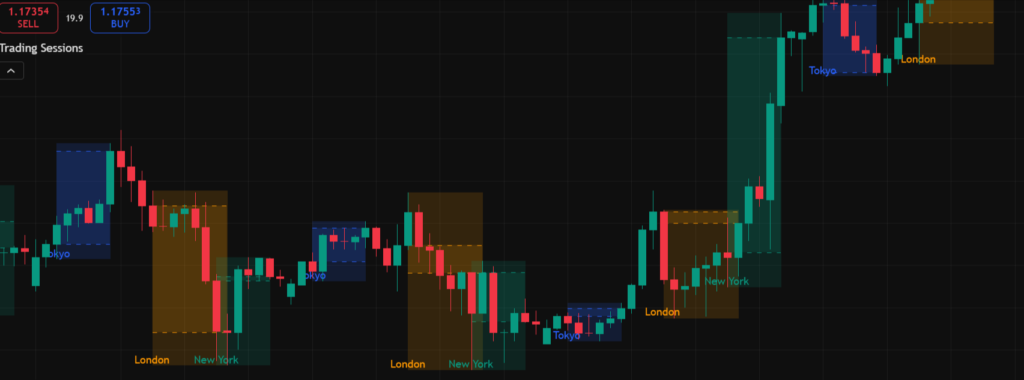
Just as there are predictable windows of high opportunity, there are also predictable periods when market activity drops so low that it works against almost any strategy. If you take timing seriously, you need to know not only when to trade, but also when to stay out because volatility is too low.
Traders often call these periods “dead hours,” and they are a major reason why a strategy that looks good on paper can feel inconsistent in real life.
Defining the Dead Hours
Dead hours are times when institutional participation and liquidity fall sharply. When that happens, price has less reason to move, and it becomes harder for your setup to play out in a clean way.
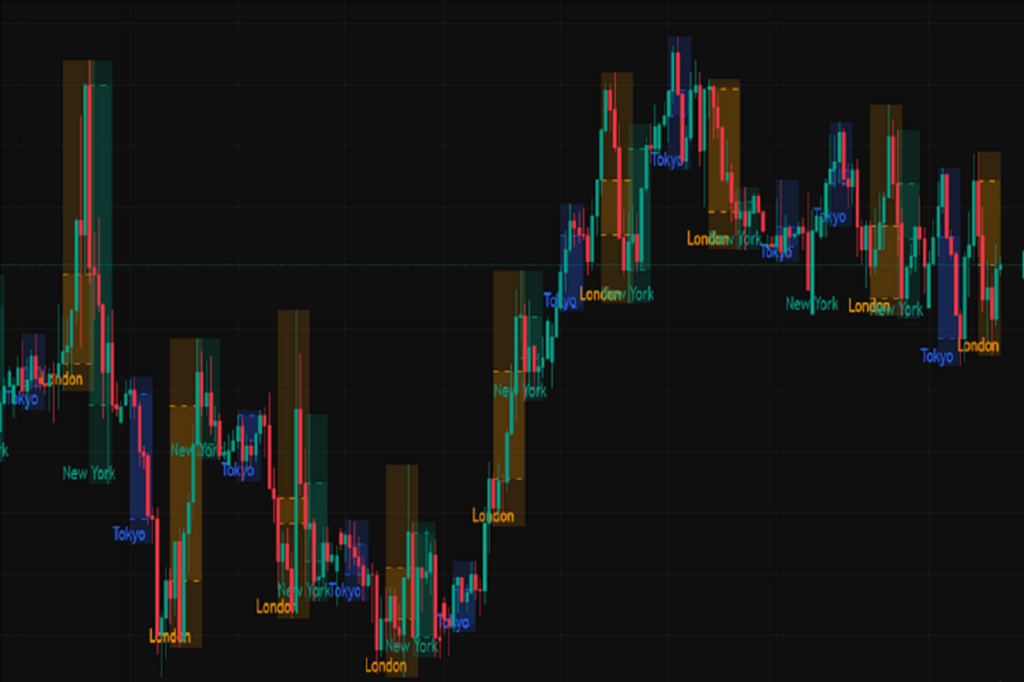
One common dead window is the Sydney-only period, right at the start of the global cycle before Tokyo volume builds. For major pairs like EUR/USD and GBP/USD, money flow is usually thin, so price action often turns flat or choppy. If you look at the chart above, you will notice that the Tokyo session is usually marked by slower price movement, with many candles showing long wicks and limited follow-through.
Another dead window is the late New York session after London closes. A large portion of liquidity leaves the market once European desks shut down, and the final hours of New York often see volume drop quickly because most of the day’s big moves have already happened.
Then there’s the weekly close on Friday afternoon. At that point, many institutional traders focus on closing positions, not opening new ones. Activity often fades quickly, and fewer traders want fresh exposure going into weekend gap risk.
What Dead Hours Look Like on a Chart
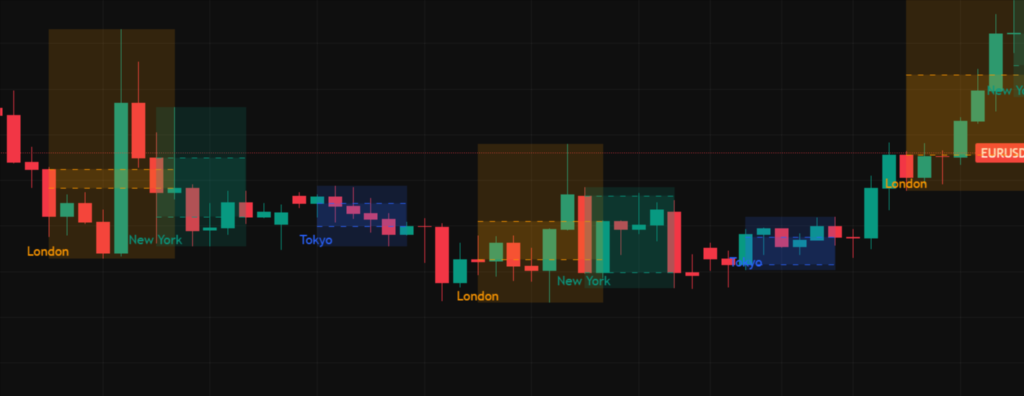
You can usually see dead hours on the chart without any indicator.
Candles often shrink because the market lacks conviction, as can be seen on the Tokyo sessions in the chart above. Price may sit in a tight range for long stretches, which makes it harder for breakouts to follow through or for trends to develop.
You also tend to see more fake breakouts. With thin liquidity, small bursts of buying or selling can push price just beyond a range, trigger entries, and then reverse back into chop. That’s one of the fastest ways to get stopped out before the real move shows up later in the day.
Costs can rise, too. Some brokers widen spreads during quiet periods, which makes your entry and exit more expensive compared to the small movement available.
The Psychological Toll of Bad Timing
Trading during the worst time to trade forex does not only hurt your P and L. It also hits your focus.
When a trade stays open for four or five hours and barely moves, you start to feel stuck. You wait longer than you planned, you get bored, and you get tired. And a tired trader often starts overtrading, taking weaker setups, opening extra positions, or adjusting a trade that did not need touching, all to force action during a period when the market is not built for it.
This is how you lose money and confidence at the same time. In many cases, the strategy is not the real problem. The market conditions made it fail.
An Actionable Challenge
If you want to see how much dead hours are affecting you, do this now. Pull up your last 20 trades. For each one, write down the entry time and which forex sessions were active at that moment. You will probably notice a pattern. Your most frustrating trades often cluster in the same quiet windows. If you cut those hours out of your schedule, you can often improve results immediately without changing your strategy.
Timing Around Economic News: Danger and Opportunity
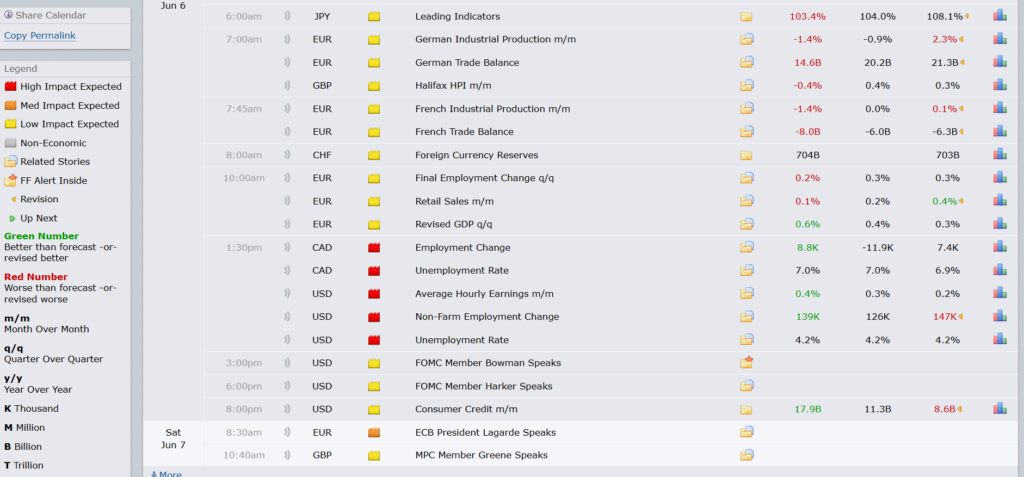
Market sessions follow a predictable daily rhythm. High-impact economic news works differently. These scheduled events can hit the market like a shock and trigger fast moves that can wreck an otherwise clean setup in seconds.
What Counts as High-Impact News
Economic news and forex volatility move together because major reports can shift expectations about rates, inflation, and growth. High-impact news is any release or statement that can quickly change how traders price a currency.
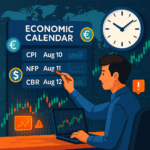
In practice, the releases you need to track most often are central bank interest rate decisions, the US Non-Farm Payrolls report, inflation and growth data like CPI and GDP, and scheduled speeches from key central bank officials.
What News Volatility Does to Your Trade
Right after a major release, price action can turn messy. You can see sudden spikes, sharp reversals, and wide swings that do not respect normal support and resistance. Stops may not fill where you expect, and spreads can widen at the worst possible moment.
A lot of traders lose money here for a simple reason. They do not know the event is coming. They enter a trade minutes before the release, assume conditions are normal, then get hit by a violent whipsaw. After that, they blame the strategy, even though the timing was the real failure.
Two Practical Ways to Handle News Windows
Because high-impact news is scheduled, you have two clean options.
The first option is to avoid the volatility. If you are still building consistency, this is usually the better choice. Check an economic calendar and stay out of affected pairs for about 15 minutes before the release and 30 minutes after it. For example, during NFP, avoid trading USD pairs in that window because the reaction can be sharp and unpredictable.
The second option is to trade the event, but only if you have a method built for it. News trading needs its own rules because normal stop sizes and normal entries often fail in that kind of movement. Traders who do this well usually control risk more tightly, allow wider room for price swings, or use structured orders that account for both directions.
Most of the time, the best time to trade around news is outside the release window. When you track the calendar, you protect your open trades and you avoid stepping into volatility you did not plan for. When you ignore it, one bad release can wipe out weeks of steady progress.
How to Test If Timing Is Your Real Problem
If your results feel random, the answer is not always a new strategy. In many cases, you need a simple, objective review of your own trading history. This is how you test your timing and find out whether your execution clock is the hidden reason your strategy feels inconsistent.
Treat this like a controlled check. You are isolating one variable, which is time, so you can see how it affects your outcomes.
The Four-Step Timing Audit
You do not need complex software for this. You only need your trade history and a spreadsheet or a trading journal.
Step 1: Gather your data.
Pull a meaningful sample so patterns can show up. Start with your last 50 trades if that’s what you have, and use 100 if you can. More data usually gives you a clearer picture.
Step 2: Add timing details to each trade.
For every trade, record the session in which you entered, which means Sydney, Tokyo, London, or New York, and note if it happened during a major overlap. Record the hour of entry in your local time because that is what you will build your routine around later. Then record the result in R, not in dollars, so you can compare trades fairly. If you risked $100 and made $200, that is +2R. If you risked $100 and lost $100, that is -1R.
Step 3: Group and compare your results.
Now sort your trades by the timing details you collected. Compare how you perform in the Asian sessions, which usually means Sydney and Tokyo, versus the European and US sessions, which usually means London and New York. Compare your trades during the London-New York overlap against trades taken when only one major session was active. Then look at your results by time blocks. You might find you lose more trades late at night, or that most wins show up in one consistent morning window.
Step 4: Look for patterns and accept what the data says.
Review the grouped results without trying to defend your past decisions. If you lose significantly more in a certain session, that session may be the worst time for your strategy. If your winning trades cluster in a consistent two to three hour window, that window is probably your strategy’s best environment.
Be honest with yourself here. If the numbers show your strategy performs well during London but struggles during the Asian sessions, the strategy may not be broken. You may simply be using it in the wrong market conditions. This audit gives you proof you can act on and it helps you build a trading routine based on what actually works for you.
Best Days to Trade Forex (and When to Avoid)
Time of day matters, but the day of the week also changes how the market behaves. You can take the same setup at the same hour and still get a different outcome because weekly flow is not equal.
A simple rule helps. The middle of the week usually offers the best balance of liquidity and follow-through, while the start and end of the week can create slow movement or messy reversals.
Monday: Often Slow, Often Choppy
Monday is often a reset day. Many institutions are positioning for the week, not pushing hard right away. Early Monday can feel like the market is awake but not committed.
If you trade on Monday, focus on your best setups only and keep expectations realistic. A lot of traders do better by using Monday for planning, watching key levels, and waiting for Tuesday when participation often improves.
Tuesday to Thursday: Your Highest-Quality Days
Tuesday, Wednesday, and Thursday tend to deliver the clearest movement. If you want consistent conditions for trend, breakouts, or clean follow-through after a setup triggers, this is usually where you find it.
If your schedule is tight, these are the days to prioritize. One good London or overlap window on a Tuesday can be worth more than three random trades spread across a slow Monday.
Friday: Strong Early, Quiet Later
Friday can start well, especially during London and the overlap. But later in the day, activity often fades because traders reduce risk into the weekend. That is when you see more slow price action, shorter moves, and less follow-through.
If you trade Friday, aim for the earlier active hours and avoid entering new positions late in the day. You do not want to hold a fresh position into the weekend unless your strategy is designed for that kind of risk.
Quick Timing Cheat Sheet (Use This to Plan Your Week)
If you only remember a few rules, remember these. Focus your trading around London and the London-New York overlap because that is when liquidity and movement are usually strongest for major pairs. Avoid dead hours like the Sydney-only period and the late New York session after London closes because price often turns flat, choppy, or full of false breaks. Treat Friday late sessions with caution because activity can drop fast as the week ends. Always check the economic calendar so you do not enter right before a major release.
One Small Detail That Prevents Time Confusion
Session times can shift slightly during parts of the year because of daylight savings changes, and your broker’s platform clock may not match UTC. The simple fix is to use one reference time in your planning, usually UTC, then convert it to your local time and confirm it on your platform once, so you trade the window you think you are trading.
Example Routine If You Can Only Trade 60 Minutes a Day
If you have limited time, your goal is not to watch charts all day. Your goal is one focused window with clear rules.
Pick one session window that fits your life, ideally London or the overlap if you trade major pairs. Spend the first 10 minutes marking the key levels, which are the prior day high and low, the Asian range if you use it, and any obvious intraday support and resistance. Spend the next 40 minutes waiting for only your best setup and taking it only if your entry rules align with active conditions. Use the last 10 minutes to log the trade in your journal, including the session, the hour, and the result in R.
If you do not get a clean setup inside that hour, you stop. That is not missed opportunity. That is discipline. Most overtrading starts when you keep watching after your best window ends.
Conclusion: Timing Turns a Good Strategy Into a Consistent One
Forex is open for long hours, but the best opportunities show up in short windows. Once you trade when liquidity and movement are strong, your setups have a better chance to play out the way they were designed to.
Build your routine around one or two high-quality windows, avoid the dead hours that drain you, and check the economic calendar so you do not walk into news volatility by accident. Then run the timing audit on your last trades. If your wins cluster in one window and your losses cluster in another, you have your answer. You do not need a new strategy. You need better timing.